How to Make Tea: The Complete Guide to Brewing the Perfect Cup Every Time
There is nothing quite as satisfying as a perfectly brewed cup of tea. But achieving that ideal balance of flavor, aroma, and strength is not just about dropping a bag into hot water. Water temperature, steeping time, leaf quality, and even the vessel you use all play a role. In this comprehensive guide, you will learn how to make tea like a professional—covering the science behind extraction, step-by-step methods for every major tea type, common pitfalls, and practical workflow you can apply immediately. Whether you are a complete beginner or a seasoned drinker refining your technique, this article will give you the exact parameters for a consistently great cup.
Key Takeaways
- Water temperature matters more than you think. Using boiling water for green tea scorches the leaves; too-cool water for black tea leaves you with a weak brew.
- Steeping time is your primary control over strength and bitterness. Over-steeping extracts tannins, while under-steeping leaves flavor locked inside.
- Tea quality scales with leaf size. Whole-leaf teas produce cleaner, more nuanced cups than fannings or dust found in most bagged teas.
- Cover your vessel while steeping to keep heat in, especially for delicate teas that require precise temperature.
- One teaspoon or one bag per 8‑ounce cup is the standard ratio—adjust only after tasting.
The Four Pillars of Tea Brewing
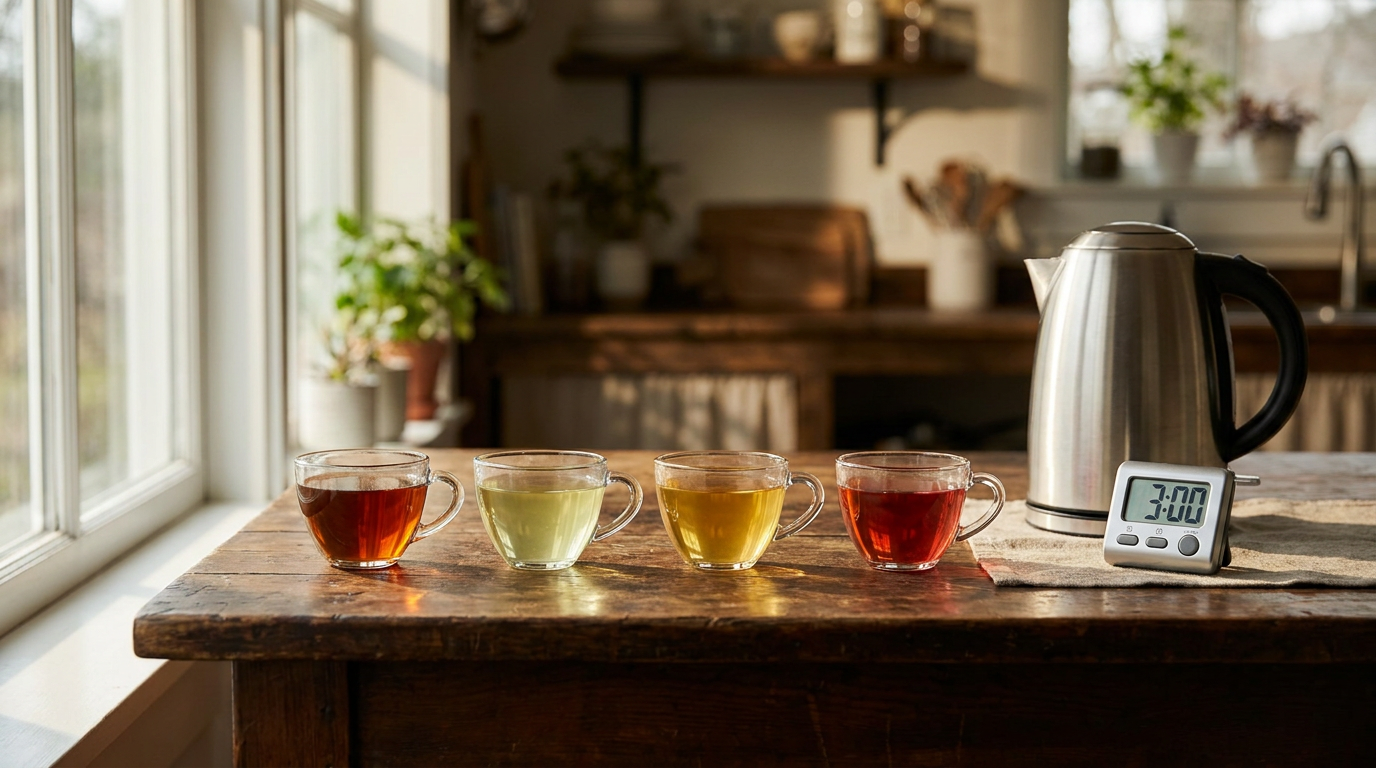
Before breaking down specific tea types, you need to understand the four variables you will control each time you brew:
- Water temperature
- Steeping time
- Tea-to-water ratio
- Water quality and freshness
Master these, and you can brew any tea with confidence.
Water Temperature: Not All Boils Are Equal
Different teas release their flavors and antioxidants at different temperatures. A general rule of thumb:
| Tea Type | Ideal Temperature (°F) | Ideal Temperature (°C) | Boil Status |
|---|---|---|---|
| Black tea | 200–212 | 93–100 | Full, rolling boil |
| Oolong tea | 180–200 | 82–93 | Rolling boil, then cool |
| Green tea | 160–180 | 70–82 | Bubbles forming (shrimp eyes) |
| White tea | 160–175 | 70–80 | Shrimp eyes, no full boil |
| Herbal/tisane | 200–212 | 93–100 | Full boil |
How to achieve the right temperature without a thermometer:
- Bring water to a rolling boil (212°F / 100°C).
- For black or herbal tea: pour immediately.
- For oolong: let water rest 30–60 seconds after boiling.
- For green: let water rest 1–2 minutes after boiling.
- For white: let water rest 2–3 minutes after boiling.
If you have an electric kettle with temperature settings, even better—use them.
Steeping Time: The Goldilocks Zone
Steeping time directly controls caffeine extraction and tannin release. Most teas have a window beyond which bitterness overpowers flavor.
| Tea Type | Standard Steep Time | For Stronger Cup | For Weaker Cup |
|---|---|---|---|
| Black tea | 3–5 minutes | 5 minutes (beware bitterness) | 2–3 minutes |
| Oolong tea | 3–5 minutes | 5–6 minutes | 2–3 minutes |
| Green tea | 2–3 minutes | 3–4 minutes | 1–2 minutes |
| White tea | 4–5 minutes | 6–7 minutes | 3–4 minutes |
| Herbal/tisane | 5–7 minutes | Up to 10 minutes (rarely bitter) | 4–5 minutes |
Pro tip: Use a timer. Guessing leads to inconsistent results.
Tea-to-Water Ratio
- Loose leaf: 1 teaspoon (about 2–3 grams) per 8‑ounce cup. For denser teas like gunpowder green, use slightly less.
- Tea bags: One bag per 8‑ounce cup. Do not use two bags unless you want a concentrated brew.
- Gongfu style (multiple short infusions): Use 5–6 grams of leaf per 100–150 ml of water.
Water Quality
Tap water with high mineral content (hard water) can mute flavor. Filtered or spring water is best. Always use fresh, cold water—reheating previously boiled water depletes oxygen and makes tea taste flat.
Step-by-Step: How to Make Black Tea
Black tea is the most common type in Western households. Full-bodied and forgiving.
- Fill your kettle with cold, fresh water.
- Bring to a full rolling boil.
- While water heats, place one tea bag or 1 teaspoon of loose leaves into a cup or teapot.
- Pour the boiling water directly over the tea leaves.
- Cover the cup or pot with a lid or saucer. Let steep for 3–5 minutes.
- Remove the tea bag or strain the leaves.
- Add milk, sugar, lemon, or honey as desired—but taste first to appreciate the base flavor.
Why cover the vessel? The lid traps heat, maintaining water temperature for consistent extraction. If you leave it open, the water cools too quickly and the tea steeps weaker.
Common Mistakes with Black Tea
- Steeping too long: More than 6 minutes produces astringent, bitter tea.
- Reusing hot water from the tap: It often contains higher iron and chlorine levels.
- Squeezing the tea bag: This releases bitter tannins. Let it drip naturally.
Step-by-Step: How to Make Green Tea
Green tea requires more care because it is not oxidized. High heat destroys the delicate leaves, producing a vegetal, harsh taste.
- Bring water to a boil, then let it cool for 1–2 minutes (target ~170°F / 77°C).
- Place 1 teaspoon of loose green tea or one bag into your cup.
- Pour the cooled water over the leaves.
- Cover and steep for 2–3 minutes. Japanese green teas (sencha, gyokuro) often need only 1–2 minutes; Chinese greens (Longjing, bi luo chun) can go 2–3.
- Strain or remove the bag immediately.
- Drink plain—milk overpowers green tea’s subtle notes.
Pro tip for loose leaf: Warm your teapot first by swishing hot water in it. This prevents the small volume of brewing water from cooling too fast.
Why Green Tea Turns Bitter
The two culprits are high temperature and over-steeping. If your green tea tastes like boiled spinach, you either used water that was too hot or steeped too long. Start with cooler water and shorter time, then adjust.
Step-by-Step: How to Make Oolong Tea
Oolong is semi-oxidized, spanning a range from light to dark. Best brewed in a gaiwan or small teapot, but a standard mug works.
Standard western method:
- Boil water and let it cool to about 190°F (88°C)—30 seconds after boiling.
- Add 1 teaspoon of oolong leaves per cup.
- Pour water over leaves, cover, steep 3–5 minutes.
- Strain and serve.
Gongfu method (for multiple infusions):
- Use 5–6 grams of leaf in a 150 ml gaiwan.
- Rinse leaves briefly with hot water, then discard.
- Steep for 30–60 seconds for first infusion, increasing time each subsequent infusion.
- Oolong can be infused 5–8 times, revealing different flavor layers.
Step-by-Step: How to Make White Tea
White tea is the least processed, with delicate flavors. It needs lower temperature but longer steeping.
- Heat water to around 175°F (80°C)—not boiling.
- Use 1.5 teaspoons of white tea leaves per cup (they are fluffy).
- Pour water over leaves, cover, steep 4–5 minutes. Some white teas (like Bai Hao Yinzhen) can steep 6–7 minutes without bitterness.
- Strain and enjoy without milk or sugar.
Note: White tea leaves can be re-steeped once or twice. Increase time by 1–2 minutes per infusion.
Step-by-Step: How to Make Herbal Tea (Tisanes)
Herbal teas (chamomile, peppermint, rooibos, etc.) contain no actual tea leaves. They can tolerate boiling water and longer steeping without becoming unpleasantly bitter.
- Bring water to a full boil.
- Add 1 tablespoon of loose herbs or one bag per cup.
- Pour boiling water over herbs, cover, steep 5–7 minutes (up to 10 minutes for deeper flavor).
- Strain and sweeten if desired.
Special case: Rooibos is naturally sweet and does not require sugar. Lemon can cause it to curdle—avoid if using milk.
A Simple ASCII Diagram of the Brewing Process
[Fill kettle with fresh cold water]
        |
        v
[Heat water to appropriate temperature]
        |
        v
[Place tea (bag or loose) in cup/pot]
        |
        v
[Pour water over leaves]
        |
        v
[Cover vessel to retain heat]
        |
        v
[Steep for exact time (use timer)]
        |
        v
[Remove leaves or strain]
        |
        v
[Add extras if desired (milk, sweetener)]
        |
        v
[Enjoy your perfect cup]
Equipment Checklist
| Item | Purpose | Good for |
|---|---|---|
| Variable-temperature kettle | Precise water temperature control | All teas, especially green and white |
| Tea infuser basket | Large space for leaves to expand | Loose leaf (any type) |
| Gaiwan or small teapot | Multiple short infusions (gongfu) | Oolong, pu-erh, white |
| Timer (phone or physical) | Accurate steeping | All teas |
| Tea cozy or thick mug | Temperature retention | Black tea, herbal tea |
Common Tea-Making Errors (and How to Fix Them)
- Weak, watery tea: Too short a steep, too cool water, or too little leaf. Increase one variable at a time.
- Bitter, astringent tea: Water too hot (especially for green/white) or steeping too long. Reduce temperature and time.
- Flat, lifeless flavor: Using stale tea or reboiled water. Always use fresh water and store tea in an airtight container away from light.
- Cloudy brew (black tea): Hard water or rapid cooling. Try filtered water; let tea cool slowly.
- Moldy smell in tea: Improper storage. Discard and buy fresh tea from a reputable source.
Tea Brewing Decision Framework
Use this quick guide when you are unsure:
- Is it Camellia sinensis? (Black, green, oolong, white, pu-erh) → Follow temperature guidelines.
- Is it herbal? → Boiling water, longer steep, no milk for citrus blends.
- Do I want a strong, bold cup? → Increase leaf amount, not time (to avoid bitterness).
- Do I want a mild, delicate cup? → Lower temperature, shorter steep.
- Do I plan to re-steep leaves? → Use gongfu ratio (more leaf, shorter initial steep).
FAQ
Q1: Should I boil the water first and then add tea, or put tea in cold water and heat together?
Always bring water to the correct temperature first, then pour over the leaves. Cold-start heating extracts compounds unevenly and often results in bitter tea.
Q2: Can I use the same tea bag twice?
Yes, but the second cup will be weaker. Steep for 1–2 minutes longer. Loose leaf is better for multiple infusions.
Q3: How do I make iced tea without it becoming cloudy?
Brew a double-strength hot tea (double the leaves, same volume), then pour over ice. The rapid cooling prevents cloudiness caused by tannins precipitating slowly.
Q4: Does adding milk before or after affect taste?
Adding milk after steeping is traditional. Milk first (as in some British practices) can coat the leaves and reduce extraction. For best results, brew tea fully, then add warm milk.
Q5: How do I store loose leaf tea?
Keep in an airtight, opaque container away from heat, light, and moisture. Do not refrigerate, as condensation can damage leaves. Use within 6–12 months for peak freshness.
Q6: What is the best temperature for matcha?
Matcha is a powdered green tea. Whisk with water at about 175°F (80°C)—boiling water destroys the delicate flavor and creates clumps.
Conclusion
Learning how to make tea is a journey of small adjustments. Start with the baseline guidelines in this article—temperature, time, ratio—and then experiment. Your palate is the final judge. Whether you prefer a brisk British builder’s brew with milk or a delicate first-flush Darjeeling taken straight, the principles remain the same: fresh water, correct heat, precise timing, and good quality leaves. Master these four elements, and you will never settle for a mediocre cup again.