How to Master the Towel Drill for Golf Swing Connection

The towel drill for golf swing connection is a practice technique where a player tucks a rolled towel under both armpits to synchronize torso rotation with arm movement. It forces the arms and chest to work as a single unified engine during the swing.
By preventing your arms from detaching from your body, this classic drill eliminates the dreaded "chicken wing" and trailing "flying elbow" faults.
Tighter connection leads to cleaner ball striking, improved distance control, and a far more repeatable action on the course.
Key Takeaways
- Ultimate Synchronizer: The drill physically blocks your arms from out-pacing your body rotation.
- Half Swings Only: You should only hit pitch shots or punch shots when tucking the towel under both arms. A full follow-through requires natural separation.
- Instant Feedback: If your arms disconnect and lift prematurely, the towel drops, immediately identifying the mechanical breakdown.
- Fixes Major Cures: Highly effective for eliminating a slice, curing the "chicken wing," and stopping over-the-top swing paths.
- Low-Tech Precision: Even with the rise of 2026 AI motion-capture apps, elite tour professionals still rely on this humble bathroom towel drill to groove their kinematic sequence.
What is Golf Swing Connection?
To understand why this drill works, you first need to grasp the concept of "connection" in the golf swing. Connection refers to the synchronized movement of your arms, hands, and torso. When a golfer is perfectly connected, the triangle formed by their shoulders and arms remains intact throughout the backswing and into the downswing.
Disconnection happens when the arms operate independently of the body pivot. You see this constantly on local muni courses: a player stops rotating their chest, but their arms keep lifting to the sky, or their hands slash at the ball while the hips stay completely still. This ruins your swing path, saps your power, and leads to highly inconsistent ball striking.
Modern kinematic sequence data from 2026 launch monitors proves that players who keep their trail tricep pinned against their chest approach the ball with vastly superior Smash Factor and clubface control. The towel drill forces your body into this exact biomechanical state.
How to Perform the Towel Drill Correctly
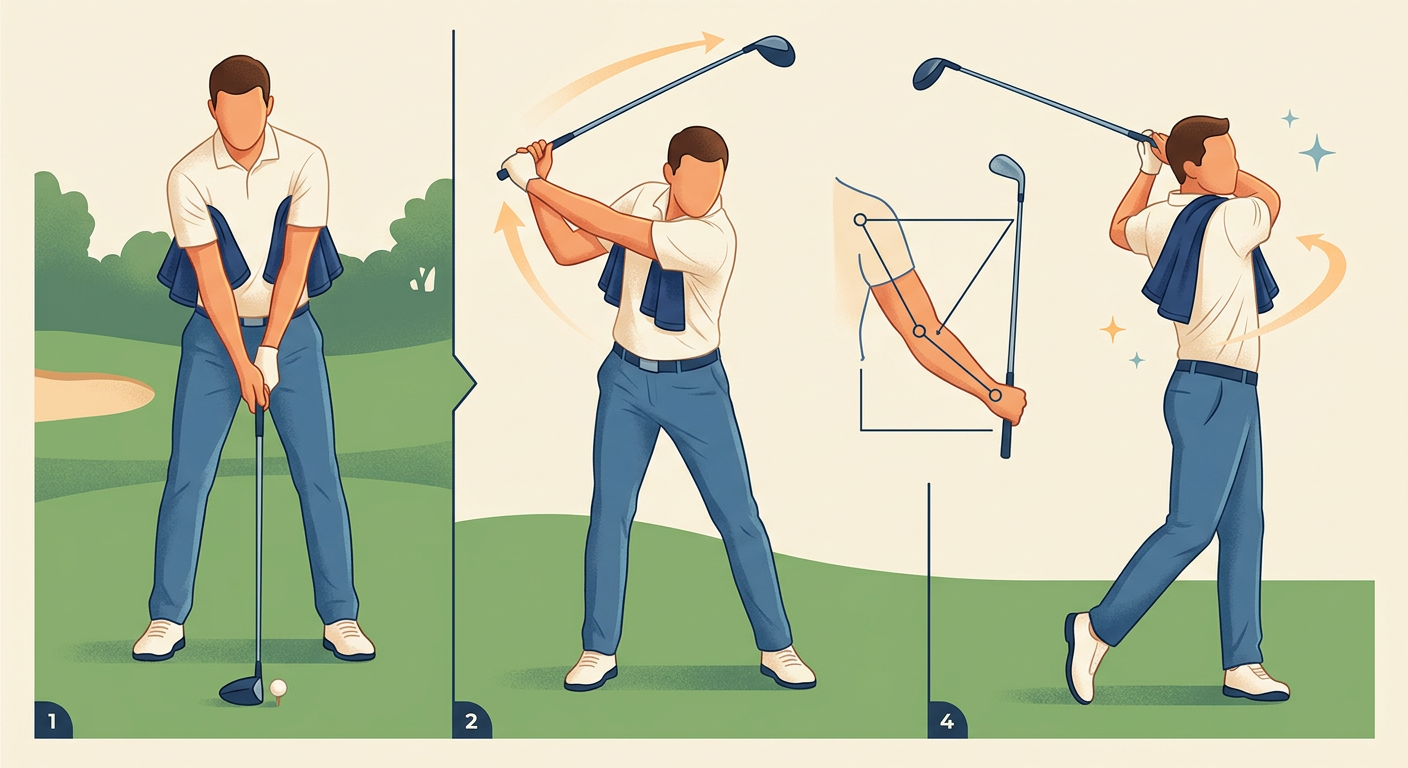
Execution is everything with the towel drill. A poorly executed drill reinforces bad habits. Follow these steps to ensure you are ingraining the right movement patterns.
1. The Setup
Take a standard-sized microfiber golf towel or a hand towel. Fold it lengthwise so it forms a long, narrow strip. Tuck the ends under both of your armpits, draping it across your upper chest. Address the golf ball with a mid-iron, like an 8-iron or 9-iron. Grab the club just an inch further down the grip than normal to promote control.
2. The Takeaway
Initiate your backswing using only your shoulder turn. Feel your chest turning entirely away from the target while keeping the towel securely pinned. Do not try to lift the club with your hands. If you lift your arms rather than turn your torso, the towel will immediately fall to the grass.
3. The Top of the Swing
Stop your backswing when your lead arm is roughly parallel to the ground (an L-to-L swing). By keeping the drill to a half or three-quarter motion, you ensure the right elbow points down and stays glued to your ribcage.
4. The Downswing and Impact
Fire your hips and unwind your core, letting the hands drop naturally into the slot. As your body rotates toward the target, the connected arms are dragged right along with it. The clubface delivers a descending blow to the back of the golf ball, compressing it.
5. The Abbreviated Finish
Rotate through to a sawed-off, chest-high finish. The towel must stay pinned under your arms until the very end of this abbreviated swing. Note: If you attempt a full pose, finishing with your hands high behind your neck, the towel will drop—and that is perfectly normal. This is why the drill is designed for punch shots.
Why the Towel Drill Works (The Benefits)
There is a reason nearly every prominent golf instructor circles back to the towel drill. It addresses multiple swing faults simultaneously by attacking the root cause: poor sequencing.
Cures the "Chicken Wing"
A chicken wing occurs when your lead elbow (the left elbow for a right-handed golfer) buckles and pulls away from your body immediately after impact. This creates a weak, slicing wipe across the ball. With a towel clamped under your lead armpit, you physically cannot chicken wing. You are forced to extend down the target line and fold your arms correctly.
Eliminates the Flying Right Elbow
During the backswing, many high handicappers allow their trail elbow to lift and flare out like a baseball batter. This flying right elbow usually triggers an over-the-top, steep downswing plane resulting in severe pulls or slices. The towel drill keeps that elbow pointed firmly at the ground, promoting a shallow, in-to-out swing path.
Stops Over-Swinging
Length does not equal power if the arms are detached from the body constraint. When you over-swing, the club dips below parallel at the top, destroying your timing. Tucking a towel under your arms restricts artificial arm-swing length, forcing you to generate power through ground reaction forces and hip rotation instead of erratic arm flailing.
Improves Wedge Play and Distance Control
Because the arms stay quiet and the body rotation dictates the speed of the clubhead, this drill is absolute magic for pitching and 50-yard wedge shots. Your low point becomes incredibly predictable, virtually eliminating chunky or thinned chips.
Towel Drill vs. Other Connection Aids
There are several ways to practice swing connection. Here is how the classic towel drill stacks up against other popular training methods.
| Training Method | How It Works | Best Used For | Drawbacks |
|---|---|---|---|
| Traditional Towel Drill | Towel tucked under both armpits during a half-swing. | Overall torso-arm synchronization; wedge play. | Restricts natural extension needed for full driver swings. |
| Glove / Headcover Drill | Tucked under just the trail armpit. | Fixing flying right elbow; allowing full swings. | Doesn't fix a lead-arm chicken wing. |
| Inflatable Smart Ball | Lanyard around the neck with a ball squeezed between forearms. | Keeping forearms tight and tracking the triangle. | Requires buying a specific training aid; bulky to carry. |
| Resistance Bands | Elastic band wrapped around the biceps to keep arms together. | Building muscle memory through physical resistance. | Can feel overly restrictive; alters natural swing tempo. |
Common Mistakes When Using the Towel Drill
Even simple drills can be ruined by bad mechanics. If you aren't seeing results, check to see if you are making one of these errors.
Trying to Hit the Driver
Do not attempt this drill with a driver or fairway wood. The golf swing naturally requires some degree of separation and extension into a high finish with longer clubs. Hitting full driver swings with pinned arms will limit your width, restrict your speed, and risk injury. Stick to the 8-iron through lob wedge.
Hunching Your Shoulders
Some golfers panic about dropping the towel and react by hunching their shoulders inward to clamp it down. This destroys your posture, limits your spinal rotation, and creates a stiff, jerky swing. Keep your chest proud, spine straight, and let the gentle pressure of the upper arms against the torso hold the towel in place.
Using the Wrong Size Towel
A massive, thick beach towel will artificially push your arms away from your body, ruining your setup. Conversely, a tiny golf glove under both arms is nearly impossible to hold without squeezing your shoulders together. A standard microfiber golf towel, rolled lengthwise, offers the perfect width across the chest.
Powerful Variations of the Drill
Once you understand the basic mechanics, you can split the drill to isolate specific issues in your swing pattern.
The Trail-Arm Only Variation
If you specifically struggle with a flying right elbow or an over-the-top move, forget pinning both arms. Simply tuck a glove, a headcover, or the edge of a towel deep under your trail armpit (right arm for a righty). You can take full, aggressive swings this way. Keeping that armpit closed drops the club shallow into the slot on the downswing, turning weak slices into powerful, penetrating draws.
The Lead-Arm Only Variation
If your main issue is chunking chips or getting the "chicken wing" through impact, place the towel only under your lead arm (left arm for a righty). Hitting 40-yard pitch shots while keeping the left bicep tight against the left pectoral muscle forces the clubface to stabilize. You will begin rotating through the shot rather than trying to scoop the ball in the air with your wrists.
Frequently Asked Questions
Should I hit real golf balls during the towel drill?
Yes, you should hit real golf balls. Start entirely with dry practice swings to get the feel of the connected motion, but advancing to hitting balls builds actual impact trust. Begin with short 30-yard pitch shots and slowly work up to full half-swings with an 8-iron.
Can I use a full swing with the towel drill?
No. You should strictly avoid a full swing when the towel is tucked under both armpits. A proper, balanced finish requires your arms to separate and extend up away from your chest. Forcing a full swing with a towel risks muscle strain and ruins your natural arc.
What size towel is best for this practice?
A standard 16×24-inch microfiber golf towel is ideal. Fold it lengthwise so it acts as a long strap across your chest. Avoid overly thick cotton bath towels that push your arms outward, and avoid tiny rags that force you to hunch your shoulders.
How long does it take to see results?
Most golfers feel an immediate difference in their contact quality within the first 20 swings. Muscular adaptation and permanent swing changes, however, usually take two to three weeks of consistent repetition. Implement it as a 10-minute warm-up before every range session for maximum benefit.
Does the towel drill cure a slice?
It is exceptional at curing a slice when the slice is caused by a flying trail elbow and an over-the-top path. By checking your arms and forcing the club to route from the inside, the drill promotes an in-to-out path which naturally produces a draw bias.
Wrap Up
Achieving an elite, repeatable golf swing doesn't require thousands of dollars in high-tech gadgets or swing sensors. Golf swing connection is built on fundamentally sound sequencing, and keeping your arms linked to your torso pivot remains the fastest route to pure ball striking.
Spend ten minutes executing the towel drill at the start of your next practice session. Start small with wedges, focus entirely on feeling your chest control the momentum of the clubhead, and accept the immediate feedback when the towel drops. Master this connected feeling, and you will dramatically elevate your consistency, accuracy, and confidence on the golf course.